
Lapiplasty vs Minimally Invasive vs Traditional Bunion Surgery Denver
Short answer: All three can correct a bunion, but they do it differently. Minimally invasive bunionectomy cuts and shifts the first metatarsal through a small incision and holds it with a temporary pin. Lapiplasty is a branded Lapidus-style fusion of a midfoot joint, usually held with permanent plates and screws. Traditional open bunionectomy uses a larger incision and often screws. No single operation is right for every foot. We pick the procedure after we see your exam and weight-bearing X-rays. At The Bunion Cure in Littleton, Dr. Jordan Sullivan most often uses minimally invasive bunionectomy for appropriate candidates, and we will tell you if a different approach suits your foot better.
Side-by-side comparison
Minimally invasive bunionectomy
Osteotomy with temporary pin
- IncisionSmall incision(s), less soft-tissue exposure
- FixationTemporary pin, commonly removed around 4 weeks; no plates or screws in our standard approach
- AnesthesiaLocal anesthesia in our typical procedure; no breathing tube or IV
- Walking & recoveryImmediate but limited protected walking in a post-op shoe; almost every patient is in a roomy normal shoe by about 4 weeks
- Who it suitsMost mild to severe bunions without significant midfoot instability or advanced big-toe arthritis; patients who want to stay mobile. For extremely severe bunions, we say up front that a small bump may remain and that the goal is about 80–90% improvement, not perfection
Lapiplasty
Lapidus-style fusion
- IncisionLarger incision and more dissection to reach and fuse the joint
- FixationTypically permanent titanium plates and screws
- AnesthesiaVaries by surgeon and facility; often sedation or general anesthesia
- Walking & recoveryProtected, often in a boot; fusion healing is generally longer and more protected. Exact rules vary by surgeon
- Who it suitsSelected feet with true first tarsometatarsal joint instability or some revision cases
Traditional open bunionectomy
Open osteotomy
- IncisionLarger open incision over the big toe joint
- FixationUsually permanent screws, sometimes a plate
- AnesthesiaVaries by surgeon and facility
- Walking & recoveryProtected walking in a post-op shoe or boot; rules vary with the cut and fixation
- Who it suitsSurgeons and patients who prefer an open technique; some mild-to-moderate deformities
Swipe sideways to see every column on smaller screens.
| Minimally invasive bunionectomy | Lapiplasty (Lapidus-style fusion) | Traditional open bunionectomy | |
|---|---|---|---|
| What it is | An osteotomy: a 3D correction in which the first metatarsal is cut, shifted, derotated and aligned in all three planes | A fusion of the first tarsometatarsal (midfoot) joint | An open osteotomy (for example a chevron or scarf-type cut), sometimes with bump removal |
| Incision | Small incision(s), less soft-tissue exposure | Larger incision and more dissection to reach and fuse the joint | Larger open incision over the big toe joint |
| Bone fixation | Temporary pin, commonly removed around 4 weeks; no plates or screws in our standard approach | Typically permanent titanium plates and screws | Usually permanent screws, sometimes a plate |
| Anesthesia (typical) | Local anesthesia in our typical procedure; no breathing tube or IV | Varies by surgeon and facility; often sedation or general anesthesia | Varies by surgeon and facility |
| Recovery and weight-bearing | Immediate but limited protected walking in a post-op shoe; almost every patient is in a roomy normal shoe by about 4 weeks | Protected, often in a boot; fusion healing is generally longer and more protected. Exact rules vary by surgeon | Protected walking in a post-op shoe or boot; rules vary with the cut and fixation |
| Joint motion | Preserves the midfoot joint | The fused midfoot joint no longer moves | Preserves the midfoot joint |
| Recurrence considerations | Corrects rotation and sesamoid position, which matter for recurrence; results depend on correct procedure selection and technique | Marketed around “root cause” correction; fusion addresses an unstable midfoot joint directly, which may matter when that joint is truly hypermobile | Older open techniques that mainly shift the bone or shave the bump may under-correct rotation in some feet |
| Who it often suits | Most mild to severe bunions without significant midfoot instability or advanced big-toe arthritis; patients who want to stay mobile. For extremely severe bunions, we say up front that a small bump may remain and that the goal is about 80–90% improvement, not perfection | Selected feet with true first tarsometatarsal joint instability or some revision cases | Surgeons and patients who prefer an open technique; some mild-to-moderate deformities |
Our experience: Dr. Sullivan has performed more than 3,500 minimally invasive bunion corrections since 2019. Our revision rate (patients who returned to have a bunion redone) is under 1%. We do not publish a clinic-specific recurrence rate; published literature puts recurrence under 5%, and returns have been uncommon in our experience.
Before & after
These are our own patients’ results — not a head-to-head outcome comparison with Lapiplasty. We don’t perform Lapiplasty, so we only show our own work here. Some swelling is still expected at 8 weeks. Individual results vary. See more in our before & after gallery.
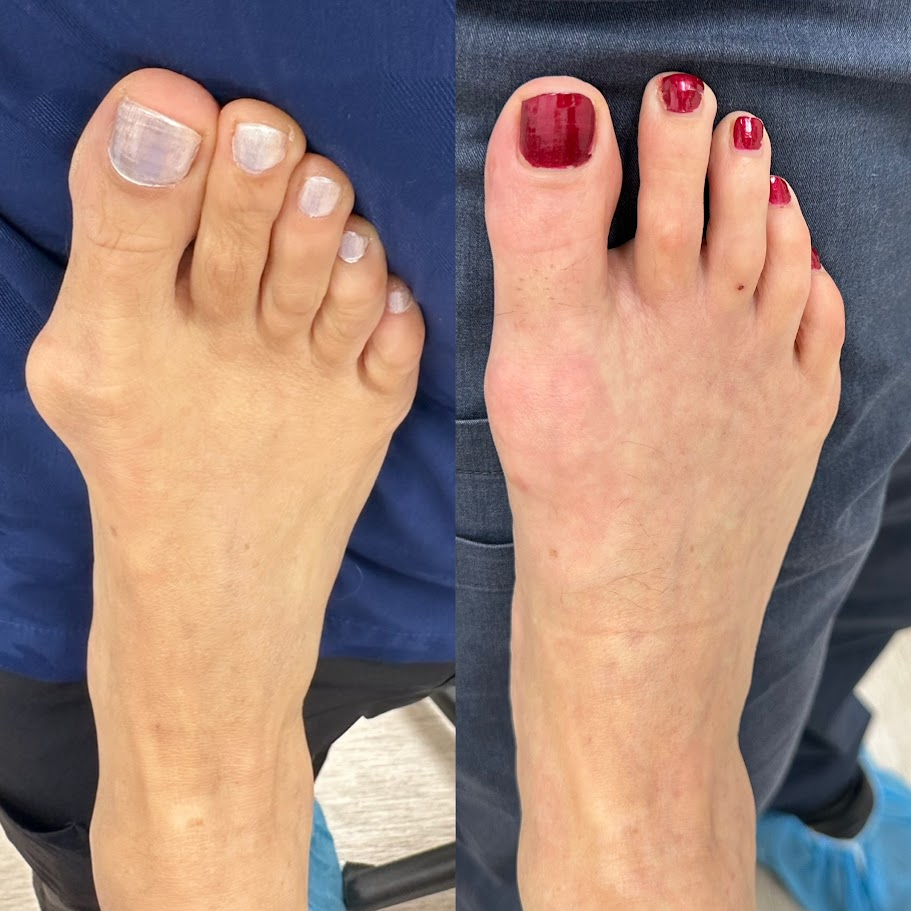
Minimally invasive bunionectomy, before and 8 weeks after.

Severe bunion and hammertoe correction, before and 8 weeks after.
Why we lead with minimally invasive bunionectomy
We focus on minimally invasive forefoot surgery because it lets us do a full 3D correction, including derotating the first metatarsal and realigning the sesamoids, through a small incision, without permanent hardware, and usually under local anesthesia. Because it is an osteotomy rather than a fusion, the bone heals more like a controlled fracture and the midfoot joint keeps its motion. Long, large published series support this approach. A smaller incision is not the whole point. The correction is.
When Lapiplasty or another approach may fit better
Lapiplasty is heavily advertised, and that alone does not make it better or worse. A fusion can make sense when the first tarsometatarsal joint is truly unstable, and some revision cases need a different plan. Advanced arthritis in the big toe joint may point to a different operation altogether. If your X-rays show one of these patterns, we will say so and explain your options, including referral when that is the right call.
What decides the right procedure for you
- Weight-bearing X-rays: severity, rotation and sesamoid position
- Midfoot joint stability and big-toe joint arthritis
- Bone quality, circulation, diabetes control, nicotine use and neuropathy
- Other problems such as hammertoes or a tailor’s bunion
- Your work, activity goals and home support during recovery
Learn more: Minimally invasive bunion surgery · Minimally invasive bunionectomy vs Lapiplasty in depth · Week-by-week recovery · Am I a candidate? · Can I walk after bunion surgery? · Before and after photos
Cost and insurance
We accept Medicare and most private insurance plans. We cannot see Medicaid patients because of Medicaid rules. What you pay depends on your plan and deductible, so we check your benefits before surgery. Call us for a personalized quote. If you have out-of-pocket costs, patient financing is available.
Frequently asked questions
Is Lapiplasty better than minimally invasive bunion surgery?
Not automatically. They are different operations. Lapiplasty fuses a midfoot joint, and minimally invasive bunionectomy corrects the bone with a cut and a temporary pin. The better choice depends on your anatomy, especially midfoot stability and arthritis.
Which bunion surgery has the fastest recovery?
In general, an osteotomy heals faster than a fusion. With our minimally invasive approach, you walk the same day in a post-op shoe with limits, the pin usually comes out around 4 weeks, and almost every patient is in a roomy normal shoe by about then. Higher-impact activity waits for clearance, often around 10 to 12 weeks.
Will my bunion come back?
Returns are uncommon in our experience. Our revision rate (patients who came back to have a bunion redone) is under 1%. Published literature puts recurrence under 5%; we do not claim a clinic-specific recurrence statistic beyond that. For extremely severe bunions, we tell patients up front that a small bump may remain. In those cases the goal is about 80–90% improvement, not perfection.
Do I need plates or screws?
Not in our standard minimally invasive approach. We use a temporary pin that is usually removed around 4 weeks. Lapiplasty and many traditional open procedures use permanent hardware.
Am I awake for surgery?
Our typical procedure uses local anesthesia, with no breathing tube or IV. Your plan is set after we review your health history.
Can you fix both feet at once?
Sometimes. It depends on your health, deformity and home support. We will talk through whether to stage or combine them.
Where are you located?
Our surgical suite is at 13402 W Coal Mine Ave, Suite 310, Littleton, CO 80127, a short drive from Denver and the southwest metro area.
Get a straight answer about your foot
Bring your questions, and your X-rays if you have them. We will tell you which approach fits your bunion and why. Contact us or call 720-758-6760, weekdays 8:30 AM to 4:30 PM.