

A callus forms wherever your foot takes repeated pressure or rubbing, so its location points to the cause. A callus under the big toe joint or along the side of the big toe often comes from a bunion or how you push off. One under the second or third toe usually means the ball of the foot is overloaded. One under the pinky toe or along the outer edge often comes from a tailor’s bunion, a high arch or narrow shoes. Heel calluses are usually from dry skin, open-back shoes or how your heel strikes the ground.
Most calluses are harmless and respond to better-fitting shoes and gentle care. A callus that keeps coming back in the same spot usually means the pressure behind it is still there.
What Is a Foot Callus?
A foot callus is a thickened area of skin that forms in response to repeated stress or rubbing. Unlike corns, which are smaller and often painful, calluses are usually larger, flatter, and painless, at least at first. They’re the body’s way of protecting itself. But they can also signal that something isn’t quite right with your foot structure, gait, or biomechanics.
The Meaning Behind Callus Locations
Where a callus forms shows where your foot takes too much pressure. Use this map as a starting point, not a diagnosis.
| Where the callus is | What it often means | What usually helps |
|---|---|---|
| Ball of the foot, under the big toe joint | Heavy load on the first metatarsal at push-off; can come with a developing bunion or a stiff big toe joint | Cushioned insole, lower heels, check for a bunion |
| Side of the big toe or over the bunion bump | Shoe rubbing on a prominent joint (bunion), or a “pinch callus” from rolling off the inside of the big toe | Wider toe box; if a bunion is the cause, the pressure returns until alignment is addressed |
| Under the second or third toe | Overload of the middle of the ball of the foot (metatarsalgia). Often seen when the big toe joint isn’t carrying its share, as with a bunion, or with a long second metatarsal | Metatarsal pad or insole; evaluation if painful |
| Under the pinky toe / outer ball of the foot | A tailor’s bunion (bunionette), a high arch, or walking on the outer edge | Wider shoes; evaluation if a bump is present |
| Outer edge of the foot | High arch or supination (rolling outward); worn outer shoe soles | Supportive shoe, insole with lateral support |
| Heel rim | Dry skin, open-back shoes, standing long hours, heel striking | Moisturizer, closed-back shoes; see a doctor if it cracks or bleeds |
| Tip or top of a toe (usually a corn) | Hammertoe or curled toe rubbing the shoe or ground | Toe-box room, padding; evaluation if the toe is rigid |
| Between toes (soft corn) | Bones of neighboring toes pressing together | Spacer, wider shoes |
| One foot but not the other | A difference between feet: a bunion on one side, a leg-length difference, or an old injury changing how you walk | Compare shoe wear; evaluation if it keeps returning |
Swipe sideways on smaller screens to see every column.
Is it a callus or a bunion?
A callus is thick skin on the surface. A bunion is the big toe joint itself shifting out of line, so the bump is bone. They often show up together: the bunion creates the pressure and the callus forms over it or under the ball of the foot. We explain how to tell them apart in Bunion vs Callus.
Safe ways to care for a callus at home
- Soak the area in warm water for 5 to 10 minutes, then gently rub it with a pumice stone or foot file. Stop before the skin is sore.
- Moisturize daily with a urea- or salicylic-acid foot cream.
- Wear shoes with room in the toe box and a lower heel, and pad the spot that rubs.
- Don’t cut or shave a callus yourself.
- If you have diabetes, poor circulation or numbness in your feet, skip home removal and medicated corn pads and have a foot doctor treat it.
Sources: American Academy of Dermatology, APMA.
When to see a foot doctor
See a doctor if a callus is painful, cracks, bleeds, drains or turns dark, if the skin around it is red or warm, if you have diabetes or poor circulation, or if it keeps returning in the same place despite better shoes.
Sources: Cleveland Clinic, Mayo Clinic.
Treating the Structural Cause of Recurring Calluses
We don’t do routine callus trimming. We fix the underlying cause, which is usually a bony prominence or a biomechanical problem that overloads the area or increases friction. We typically address that root cause with surgery rather than repeated trimming. When a bunion is pushing the big toe joint out of line, the callus on the side of the toe or under the ball of the foot often returns until the alignment is corrected. Our minimally invasive bunionectomy is a 3D correction: we realign the first metatarsal in all three planes (side to side, up and down, and rotation) and bring the sesamoids back under the joint. Whether surgery makes sense for you depends on your exam and weight-bearing X-rays.
Learn more: minimally invasive bunion surgery · Am I a candidate?
What to Tell Us at Your Consultation
Tell us where the callus develops, whether it hurts, how often it returns, and which shoes or activities bother it. Let us know what you have already tried and whether you have had previous foot surgery.
Meet Dr. Sullivan or request a free consultation to discuss your concerns.
Medically reviewed by Jordan Sullivan, DPM · Updated November 9, 2026
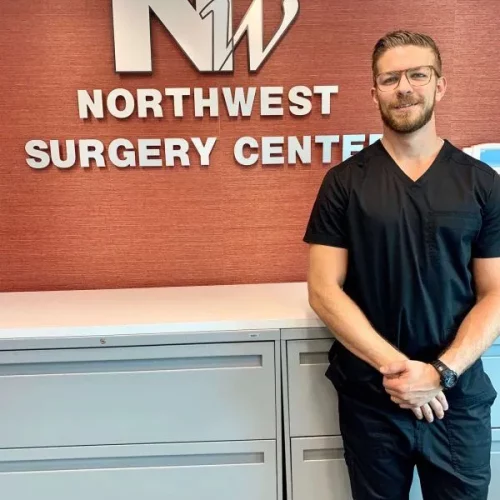
Reviewed By Dr. Sullivan
Dr. Jordan Sullivan, DPM, is a podiatrist board certified by the American Board of Podiatric Medicine (ABPM) at Northwest Surgery Center specializing in minimally invasive foot and ankle procedures. He’s passionate about helping patients get back on their feet faster with less downtime.
Learn more about Dr. Sullivan here.
